By Tour Types
By Gateway Cities
By Gateway Cities


5 Days Lhasa & Namtso Lake Group Tour
5 Days Lhasa & Yamdrok Lake Group Tour
6 Days Lhasa & Shigatse Group Tour
7 Days Lhasa to Kathmandu Overland Group Tour
8 Days Everest Base Camp Group Tour
9 Days Lhasa & Everest & Namtso Lake
10 Days Lhasa & Everest & Namtso Lake
14 Days Mt. Kailash Trek & Pilgrimage Group Tour
15 Days Mt. Kailash Trek Group Tour
Tibet Permit & VisaTibet Travel FAQsTibet TrainsTibet FlightsTibet AttractionsTibet HotelsTibet MapsAltitude SicknessWeather & ClimateCustom & Trandition
Tibet ShoppingFood & DinningEtiquettes & TaboosTibetan BuddhismTibetan HistoryCulture & ArtsTibetan FestivalsTibetan MedicineWhat to PackTibetan People

Tibet has traditionally been the home of a subsistence agriculture and herding economy. For the most part there was no currency, only barter until 1960s. The feudal system has only recently been displaced.
Economic Improvements in Tibet
Due to the government planning has greatly increased the productivity of the Tibetan economy. In recent years there have been advances made towards tourism, mining, and other businesses which provide construction materials. The Chinese government has developed plans to increase the productivity of the mining industry. Recently in the highlands of Tibet large deposits of minerals have been found, many which are vital to industry. Types of minerals such as: aluminum, copper, iron, lithium, and others. These minerals were found near to the Lhasa railway which could provide for an easier access. With the plans set into motion for the development of the mining industry in Tibet, this province could provide for a positive increase in the Chinese economy. Tourism has been encouraged in recent years and has provided new jobs for the Tibetans. It has helped to relieve some of the over-grazing of the steppes of Tibet due to the traditional herding. Also the government of China has begun and continued to put funding into restoring Tibetan historical monuments and provide for new museums. The art of Tibet is beginning to be preserved in monuments and in museums. The Potala Palace has been a major source of traveler interest and due do this influx, visitors have been regulated. The government has regulated visitors to help preserve the integrity of the Potala Palace’s structure. Even with these increases in tourism and mining; agriculture and livestock continue to be the highest source of income in Tibet. With Tibet’s increasing drive for infrastructure and development it should prove to be a productive economy within China in the years to come.
China-Tibet Tea Horse Road
For many centuries the Tea Horse Road was a thoroughfare of commerce, the main link between China and Tibet. The ancient passageway once stretched almost 1,400 miles across the chest of Cathay, from Yaan, in the tea-growing region of Sichuan Province, to Lhasa, the almost 12,000-foot-high capital of Tibet. One of the highest, harshest trails in Asia, it marched up out of China's verdant valleys, traversed the wind-stripped, snow-scoured Tibetan Plateau, forded the freezing Yangtze, Mekong, and Salween Rivers, sliced into the mysterious Nyainqentanglha Mountains, ascended four deadly 17,000-foot passes, and finally dropped into the holy Tibetan city.
Tea portering ended soon after Mao took over the country in 1949 and a highway was built. Redistributing land from the wealthy to the poor, Mao released the tea porters from servitude. "It was the happiest day of my life," Luo said. After he received his parcel of land, he began to grow his own rice and "that sad period passed away."
Business in Tibet
The number of businesses in Tibet rose from 500 in 1993 to 41,000 in 2003. The Chinese government has offered tax breaks and other incentive to foreign investors who are willing invest in Tibet. Joint ventures for making motorcycle engines and cashmere knitwear have been set up. Beijing has also ordered every Chinese province and several state companies to invest in Tibet. Lhasa has a stock exchange.Many of the businesses in Tibet are owned by Chinese. Many have few Tibetan employees or even Tibetan customers. Almost everything that is sold in Tibet comes from China. Tibetans say the Chinese have better guanxi (connections) and more developed business sense.
Resources in Tibet
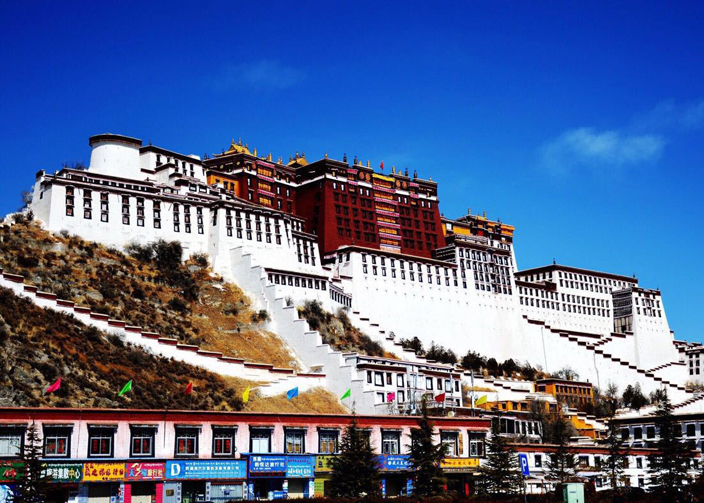
Tibet has more than 3,000 proven mineral reserves, including China biggest chromium and copper deposits. China Daily, an official English-language newspaper, quoted a Tibetan official in March saying that mining could make up at least 30 percent of Tibet gross domestic product by 2020, up from 3 percent now.
Chinese geologists have found new deposits of copper, iron, lead, and zinc, and possibly oil, accessible to the train route. Total possible reserves have been estimated 20 million tons of copper and 10 million tons of lead and zinc.
Tibet contains half the world's lithium reserves, almost all of it from a single mine in northeRn Tibet. China’s largest chromium deposits and it third largest copper mine are in Tibet. There is also gold, uranium, diamonds, silver, boron, antimony and borax.
Gold, turquoise and other gems comes from three specific areas in the southern and western Tibet. In the late 1980s and early 1990s there was huge gold rush in western Qinghai. Thousands of illegal gold diggers flocked to region and disrupted the fragile environment there. In July 2010, China National Gold Group, the nation largest gold producer, began work at a polymetallic mine whose daily output is expected to reach 15,000 tons.
Industries in Tibet
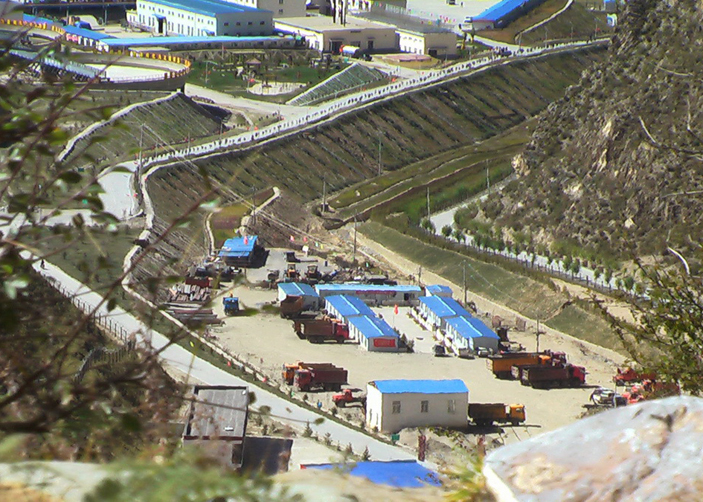
Traditional Tibetan trades include flour milling, canvas painting, paper making, rope braiding, wool and fiber processing, weaving and textile production, tanning, metalwork, carpentry, and wood carving. Small scale and household production has traditionally been the norm. Large monasteries produce books, religious manuscripts and religious objects on an industrial scale. See Dege, Places.